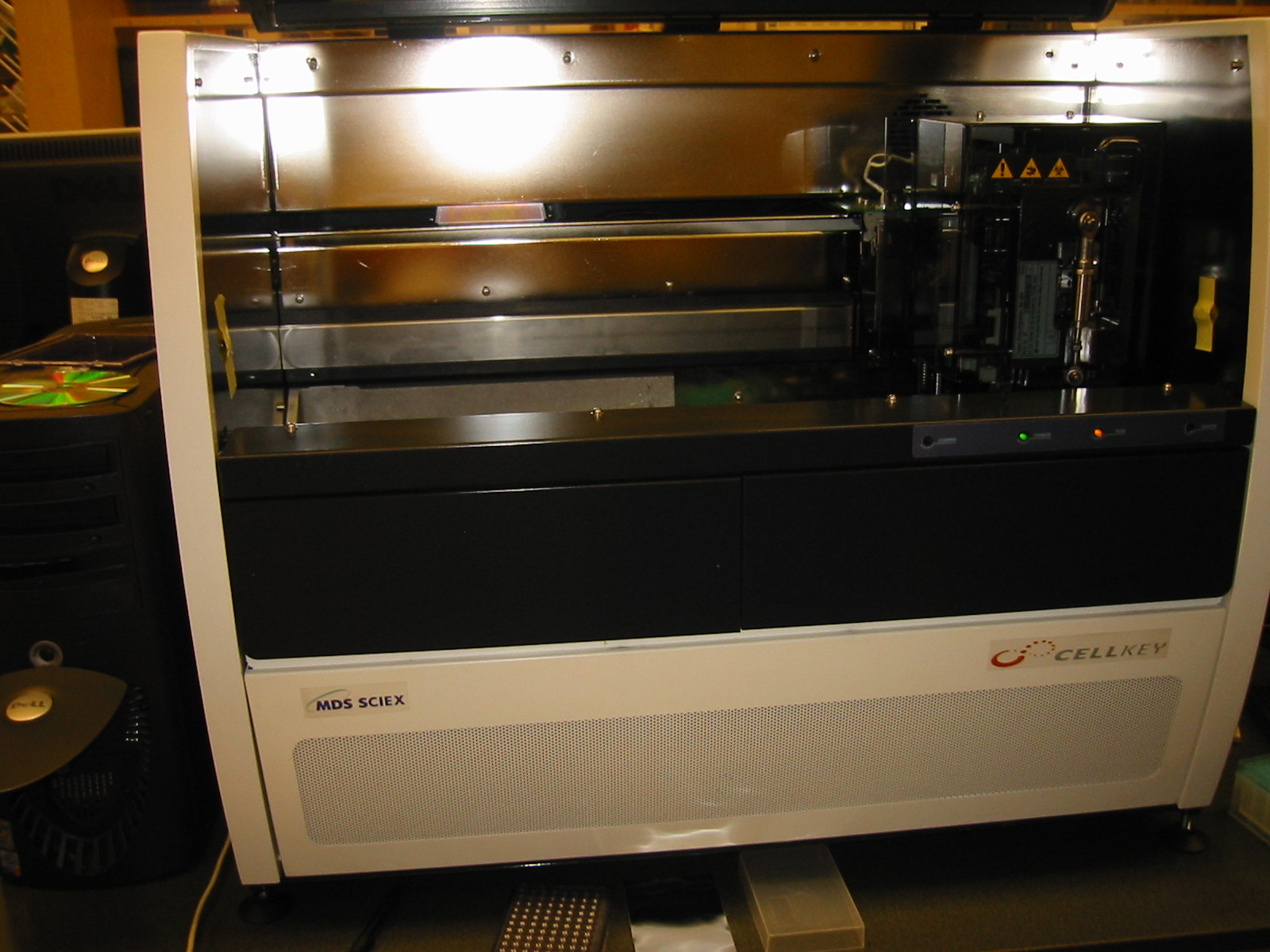
CellKey prototype
Posted: November 10, 2005 at 10:36 pm in journal ~ Permalink ~ TrackBack


This evening, Sciex had a product launch party for the CellKey instrument, inviting those of us who had worked on it at both Signature and Sciex to come by and see the prototype instrument. It was great to see a bunch of the old gang again, and catch up on what people are doing.
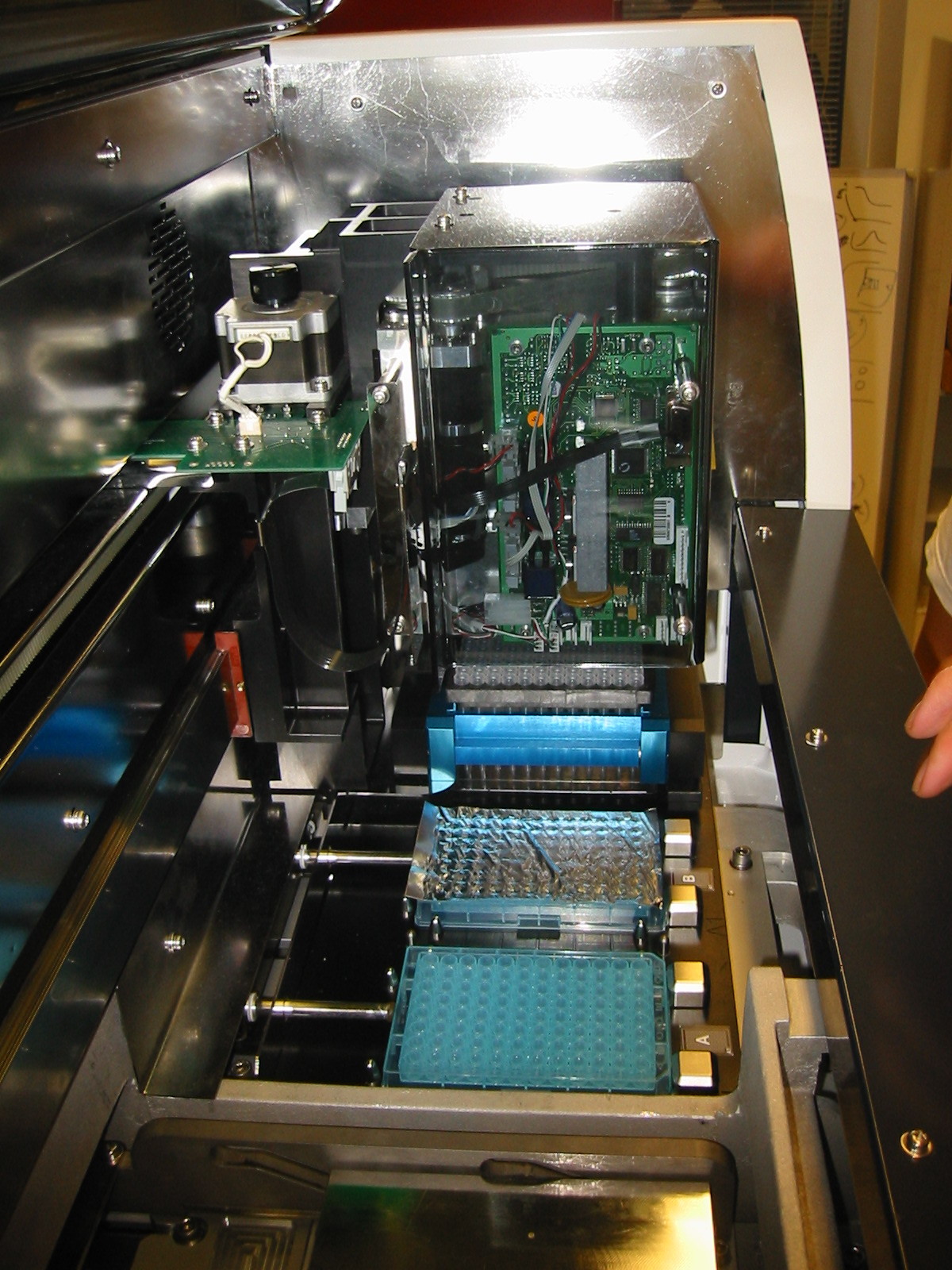

It was also great to see the instrument in real life. I was on the project from its beginning at Signature, when a biologist and an engineer got me to modify some software for them so they could study what would happen when they dosed cells with drugs. Two years at Signature, another two and a half years at Sciex, and it’s gone from an experiment in a back room to a product released by a multinational corporation. Quite the ride.
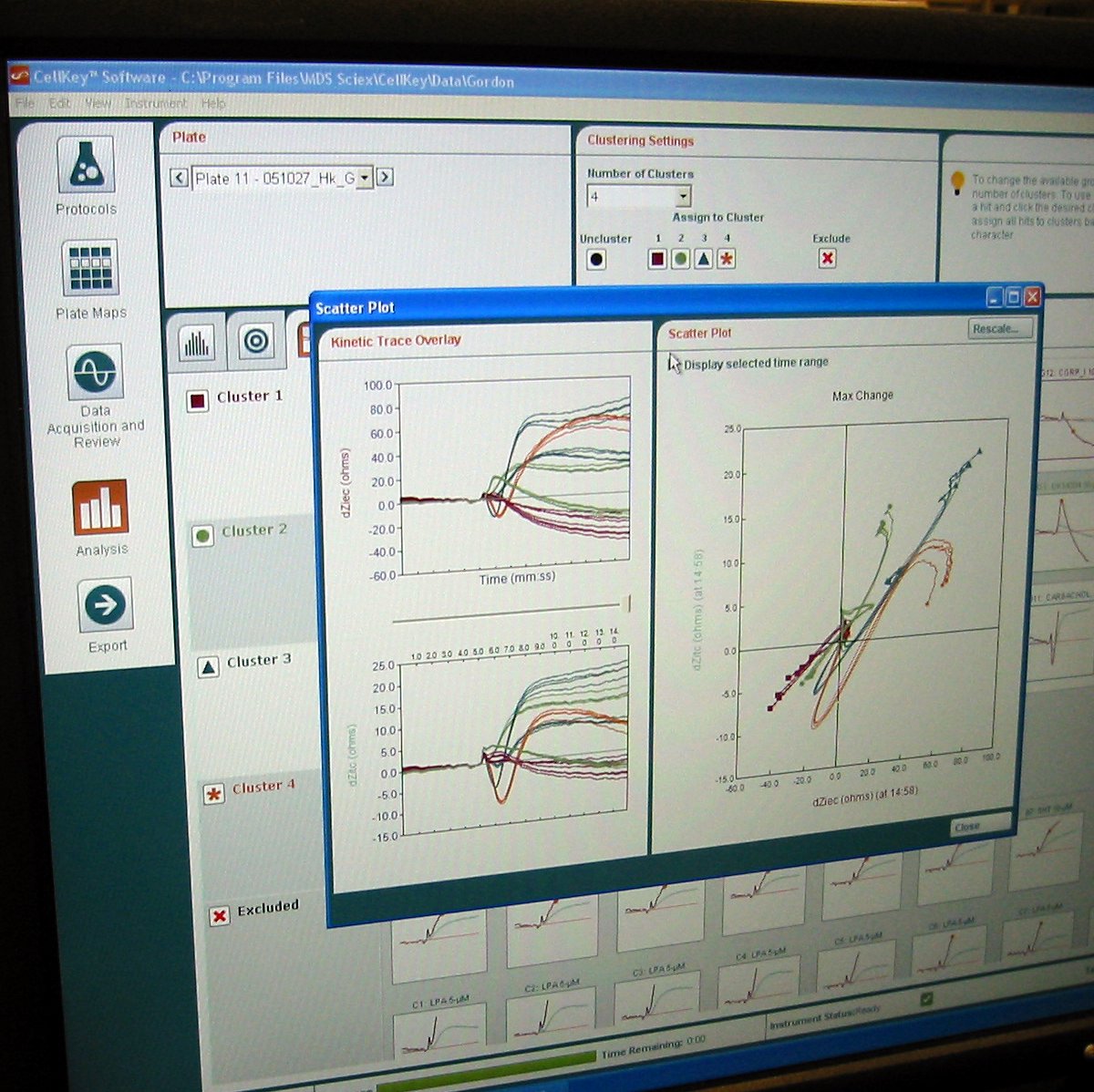

It’s also pretty gratifying to see how the final production version of the software turned out. I did a lot of the prototype software, as well as a lot of the algorithm development, and even went along on several customer visits with the user interface team to help gather requirements for the production software. I was on the team that helped to design the production software, but never got to see it in action, so that was neat. Especially when my former coworkers told me that my analysis algorithms are still working well.

In case you care, the CellKey ™ instrument is, to quote the website, “a label-free, universal, functional cell based assay technology that allows the measurement and analysis of receptor activation in live cells.” In other words, you have a plate of cells, you add reagents to them, and you can see what happens via the “Cellular Dielectric Spectroscopy” technology. Check out the video on the website for the marketing description.

Also, you should be aware that:
Previous: 4S conference and LA | Next: More books by Shinn and Gould


  1. Eric Nehrlich, Unrepentant Generalist || The Only Sustainable Edge, by Hagel and Brown || May || 2006 commented on May 5th, 2006 at 8:24 am :

    [...] One other idea I liked was their concept of “productive friction”: “When people with diverse backgrounds, experiences and skill sets engage with each other on real problems, the exchange usually generates friction - that is, misunderstandings and arguments - before resolution and learning occur. … Yet, properly harnessed, friction can become very productive, accelerating learning, generating innovation, and fostering trust across diverse participants.” Since I have generally worked in interdisciplinary environments and have witnessed the clashing worldviews firsthand, I appreciate both the downsides and upsides of such friction. The CellKey instrument would never have happened without a team of biologists, physicists and engineers working closely together for years, but we definitely had moments of friction - at one point, just after we’d gotten picked up by Sciex, the team spent a solid week in a conference room just getting all of our terms and definitions straight so that we were all speaking the same language. [...]

  2. Eric Nehrlich, Unrepentant Generalist || Team player || June || 2007 commented on June 22nd, 2007 at 8:47 am :

    [...] teams are more than the sum of their individual members. The CellKey team was forced to work cooperatively because none of us knew enough about each others’ [...]

  3. Eric Nehrlich, Unrepentant Generalist || SBS Award for CellKey || October || 2007 commented on October 28th, 2007 at 12:01 pm :

    [...] Over the next two years, we studied the phenomenon far more closely. We learned that what we were seeing in our results was the ways in which the cell changed in response to the initial binding event. The cell was essentially acting as a biological amplifier for the binding event, creating effects big enough for us to see and measure consistently. We figured out how to mathematically characterize the different signals we were seeing so that we could give biologists meaningful results; instead of 60-dimensional bioimpedance data, the program could spit out “This looks like a Gq pathway”. We worked with partner companies to test out the technology with their experiments and passed all of the tests successfully. The technology was scaled up and released as the CellKey instrument in September 2005, and it was incredibly satisfying to see the finished product. [...]


Speak up!

Line and paragraph breaks are automatic.
Allowed tags: <a href=""> <blockquote> <code> <em> <strong>